-

-
Please adjust the volume.
1H26 Business Results
Greetings, everyone. I am Jerry Kang, Head of KBFG IR Department.
We will now begin the 2026 first half business results presentation. Thank you very much for participating in today's earnings release.
We have here with us today business results presentation, our Group CFO, Sang-Rok Na, as well as executives from our group.
Regarding the agenda today, we will first have our Group CFO deliver the 2026 first half business results and then have a Q&A session. We will now have our Group CFO, deliver a presentation on 2026 first half business results.
Greetings, everyone. I am KBFG CFO, Sang Rok Nah. Thank you very much for taking part in the 2026 first half earnings release.
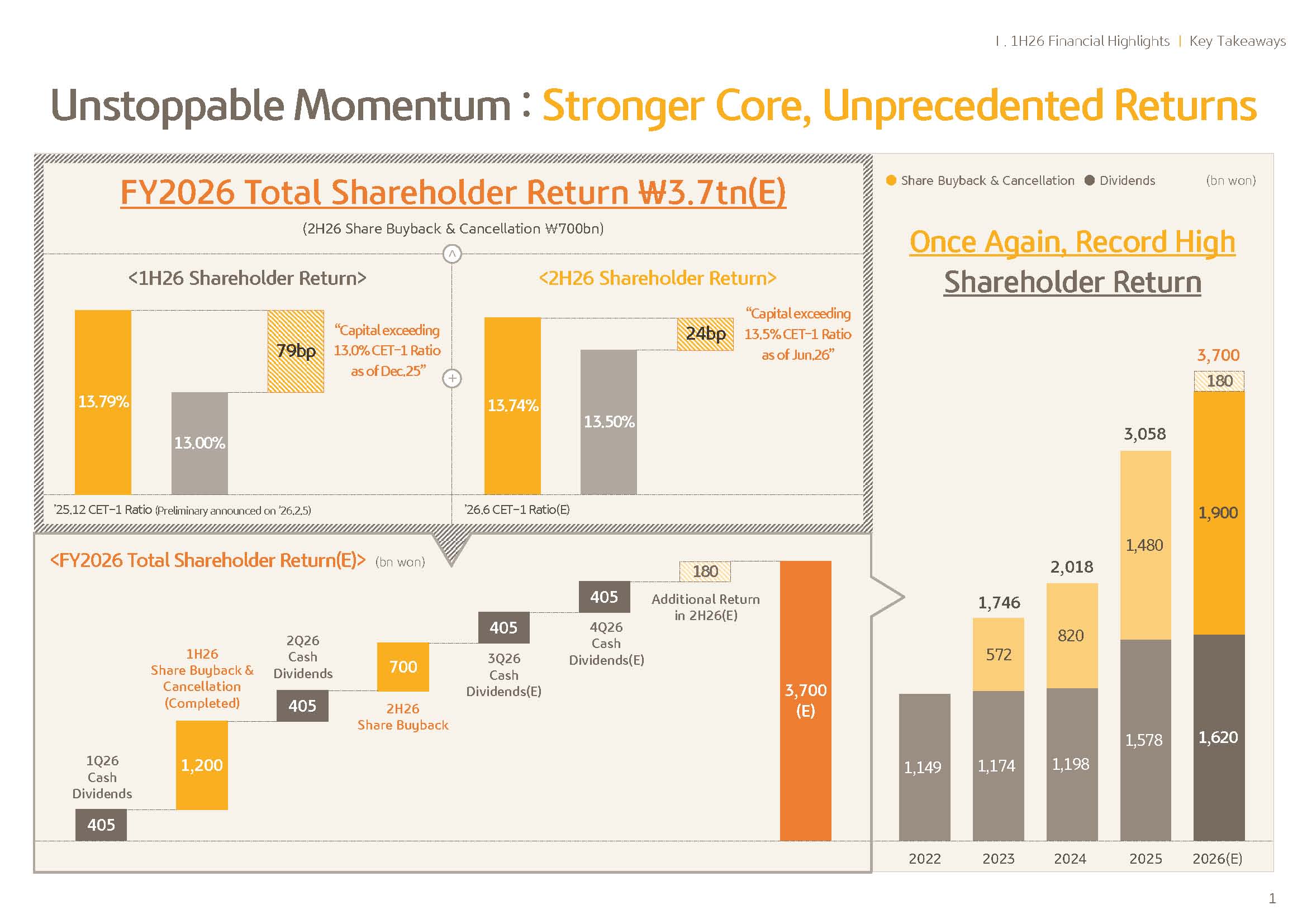
Before we proceed with the business results presentation, I would first like to cover the first half shareholder return approved at today's BOD meeting. Let's go to page 1.
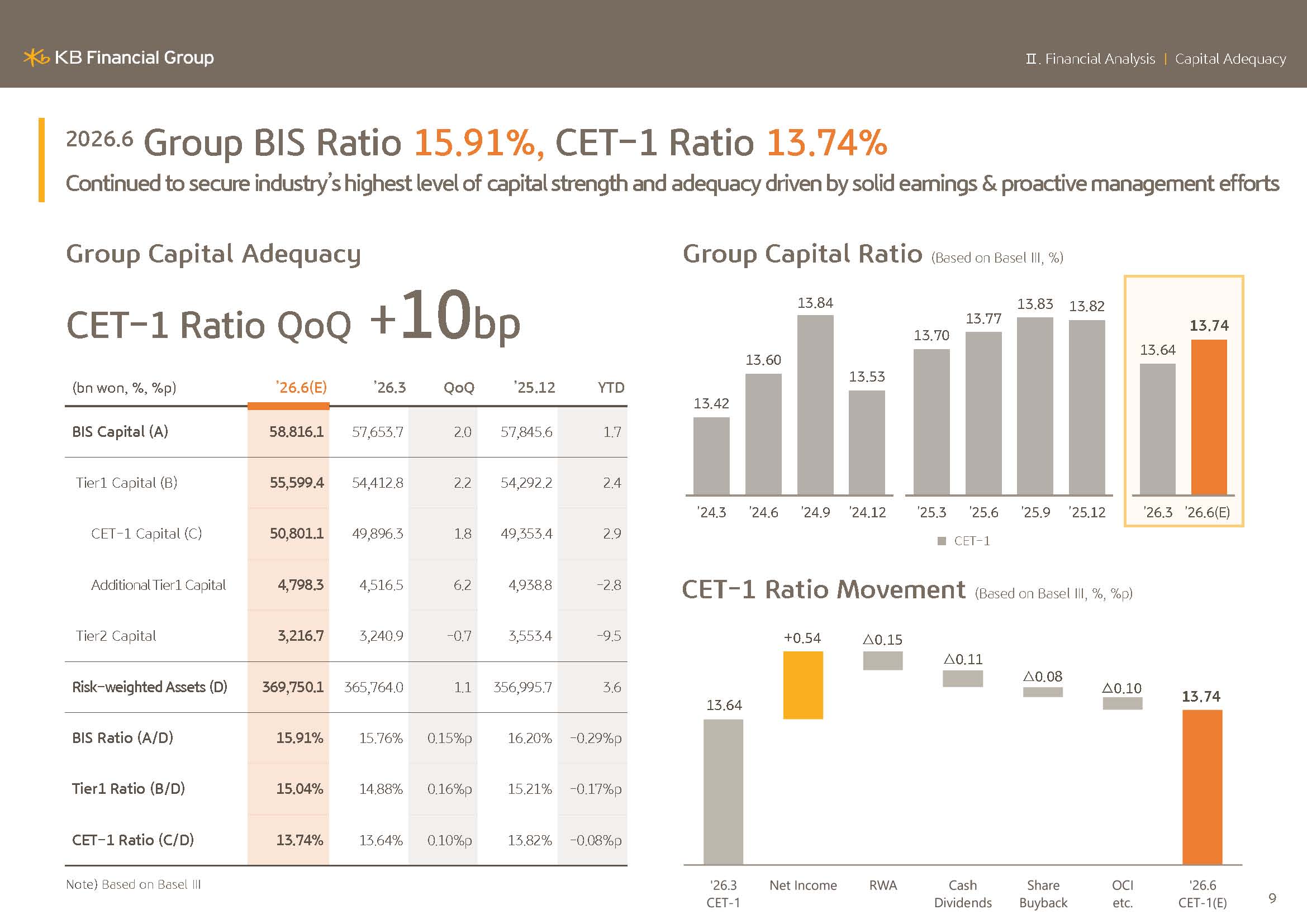
Despite the operating environment in the first half of the year marked by high FX rate and heightened financial market volatility through strategic capital management efforts, June end group CET1 ratio posted 13.74%, a 10 bp improvement compared to the previous quarter end. According to KB's shareholder return framework, capital that exceeds 13.5% CET1 ratio will be utilized for our second round of shareholder return in 2026.
At today's BOD meeting, it was decided to carry out, firstly, KRW700 billion of share buyback and cancellation. Regarding the remaining surplus capital, we will comprehensively take into account our earnings, PBR, and dividend yield trends at the end of fiscal year 2026 and use this to fund additional shareholder returns.
For your reference, if we take into account the KRW2.82 trillion of the 2026 first round of shareholder returns, which was announced in February, we expect to post KRW3.70 trillion as our 2026 annual total shareholder return.
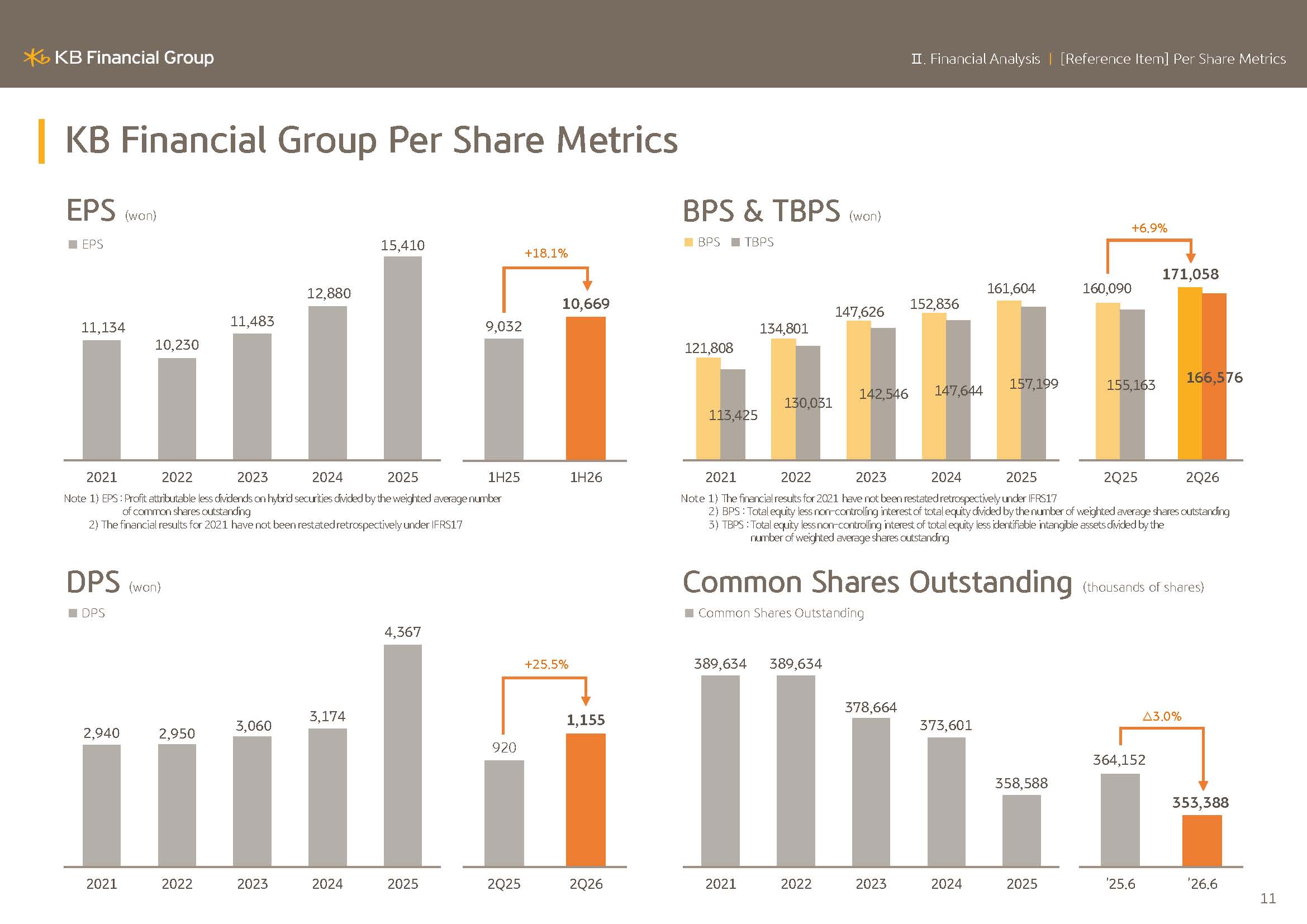
We will deliver on our commitment to the market to maintain industry-leading level across all shareholder return metrics. And going forward, we plan to consistently maintain our differentiated shareholder return policy based on our stable earnings generation capacity. In addition, at today's BOD meeting, a cash dividend of KRW1,155 per share for Q2 was approved.
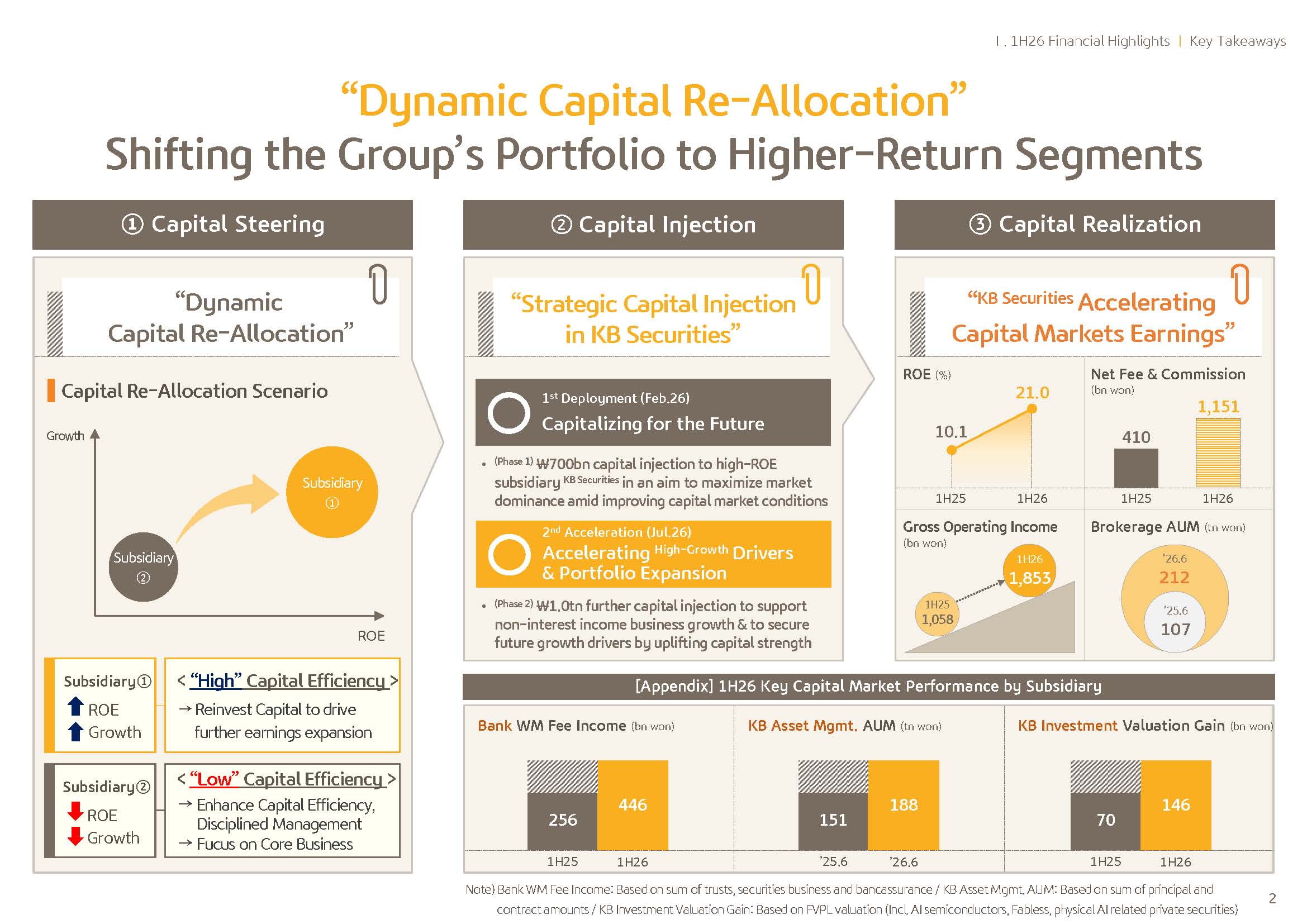
Let's go to page 2. Through strategic reallocation of capital, reflecting the operating environment and growth prospects of each business segment, we are continuously strengthen a virtuous cycle that enhances capital efficiency across the group and at the same time, reinvesting in subsidiaries with strong growth potential.
As a part of these efforts in order to absorb the full capital market money moving into our recurring earnings base, we decided on 2 rounds of paid-in capital increase totaling KRW1.7 trillion. This represents a more efficient and dynamic allocation of capital across the group, whereby capital generated by core subsidiaries, including the bank is reinvested in the securities business, which offers growth potential, which is strong. Our security subsidiary plans to utilize the capital secured to proactively respond to changes in the WM market while providing venture capital and supporting productive finance by expanding its promissory note business and fulfilling the requirements ahead of time for IMA authoritization.
Going forward, we will further strengthen our group's medium- to long-term earnings base across businesses with strong growth potential and high capital efficiency, including the Capital Markets segment.
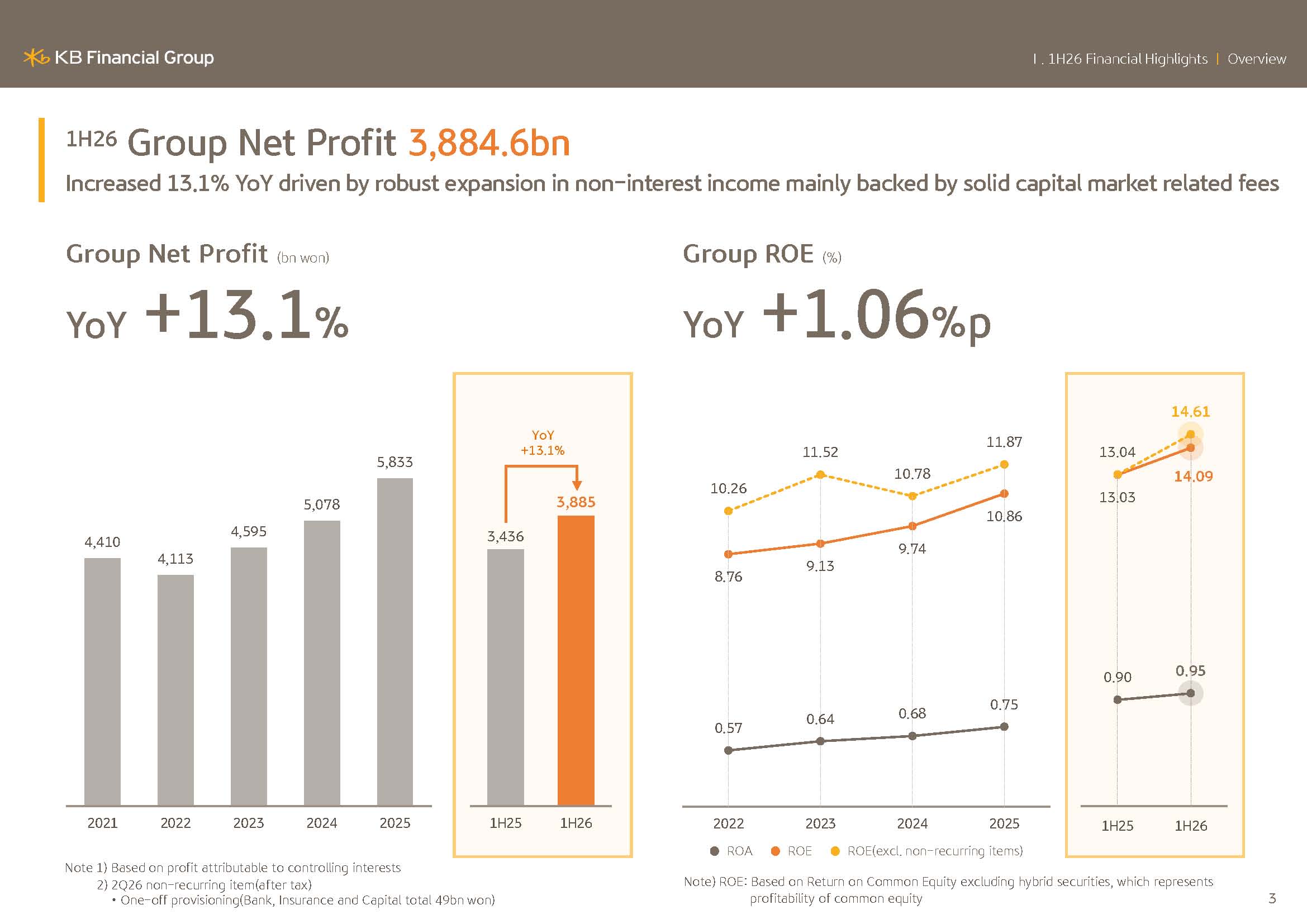
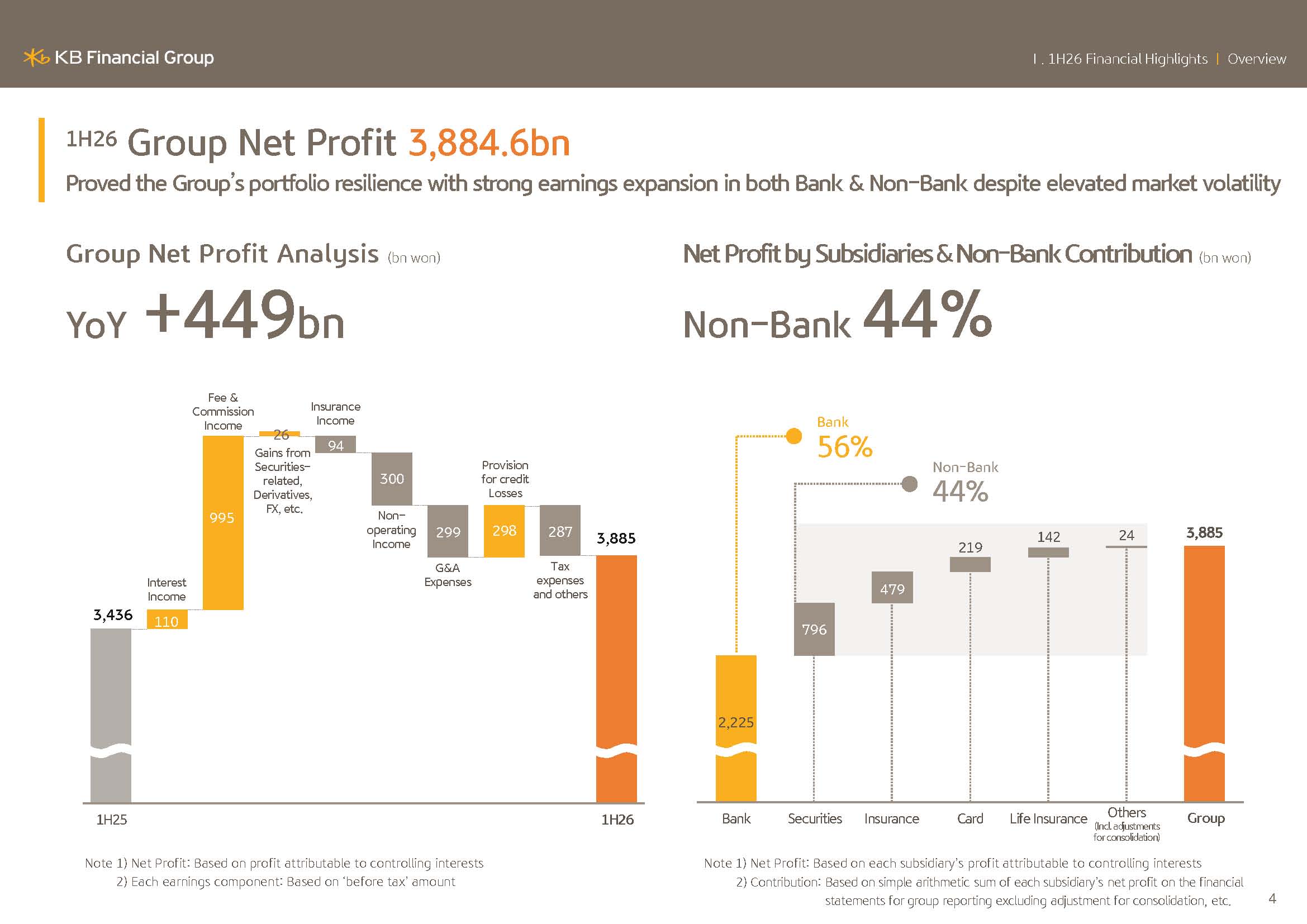
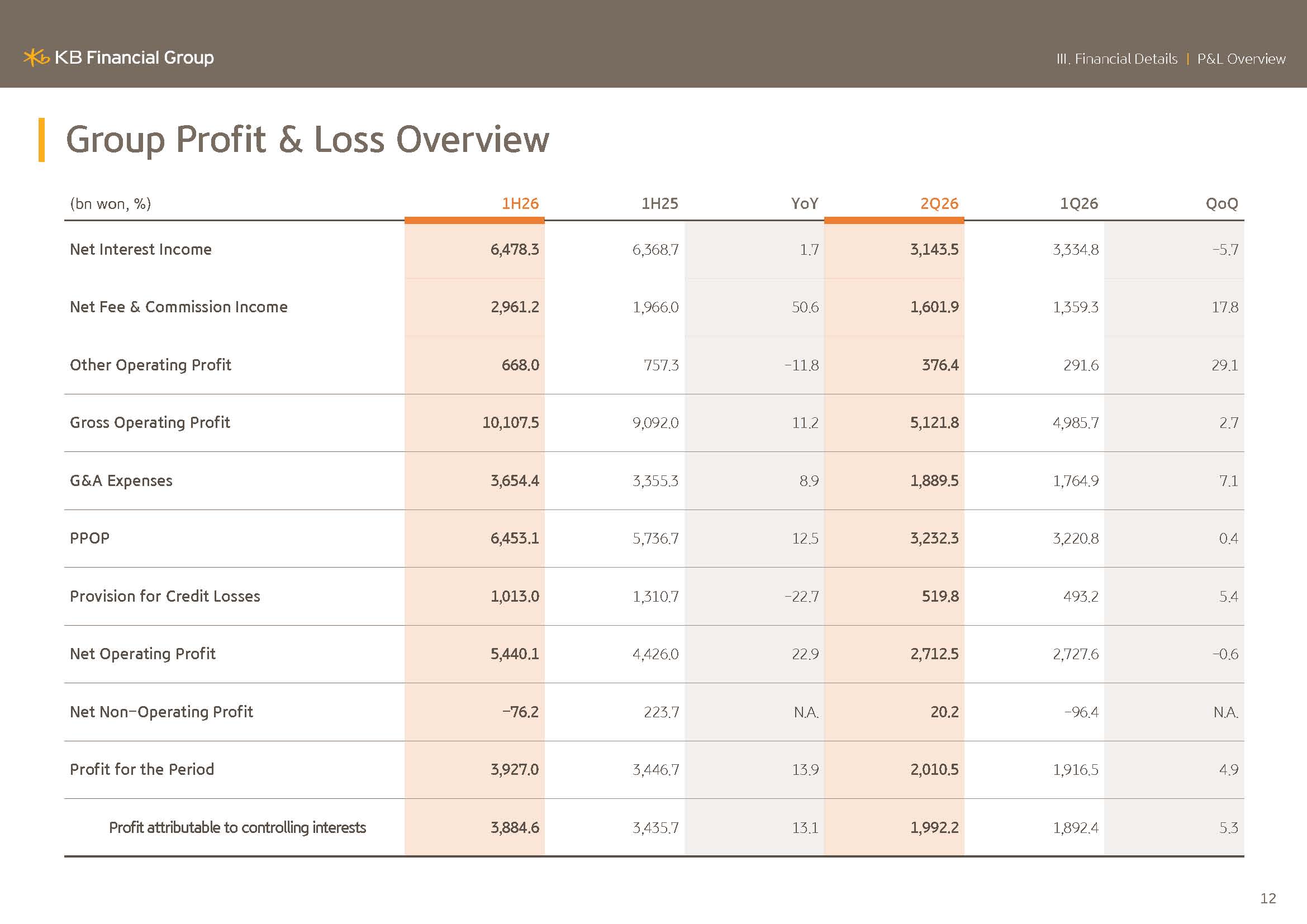
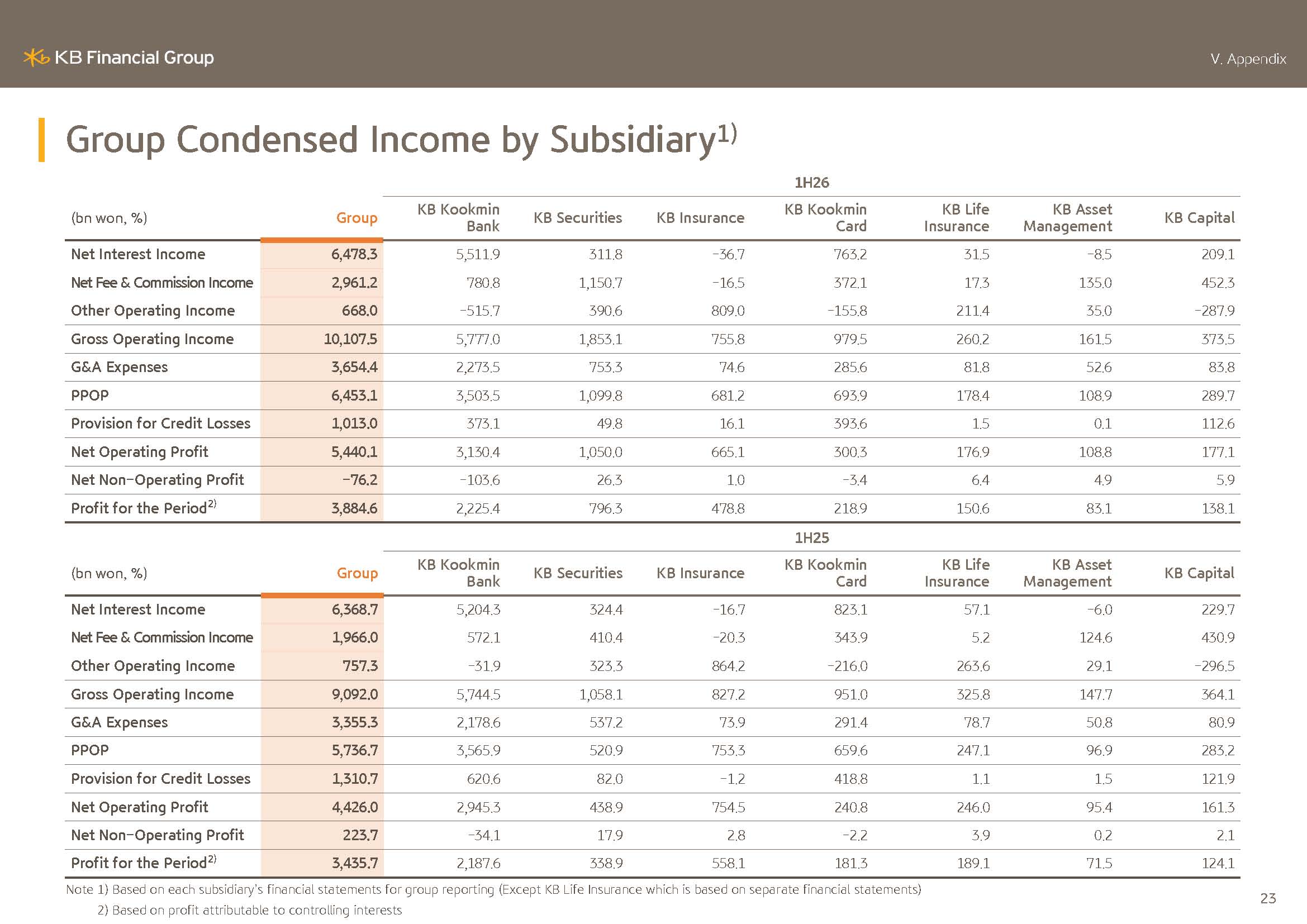
Next, I will cover business results. Q2 net profit posted KRW1.9922 trillion. And on a first half cumulative basis, it posted KRW3.8846 trillion, a 13.1% increase YoY. This was driven by a significant increase in fee income, which pushed the group's first half total operating income above KRW10 trillion for the first time in its history and sustained its stable growth momentum.
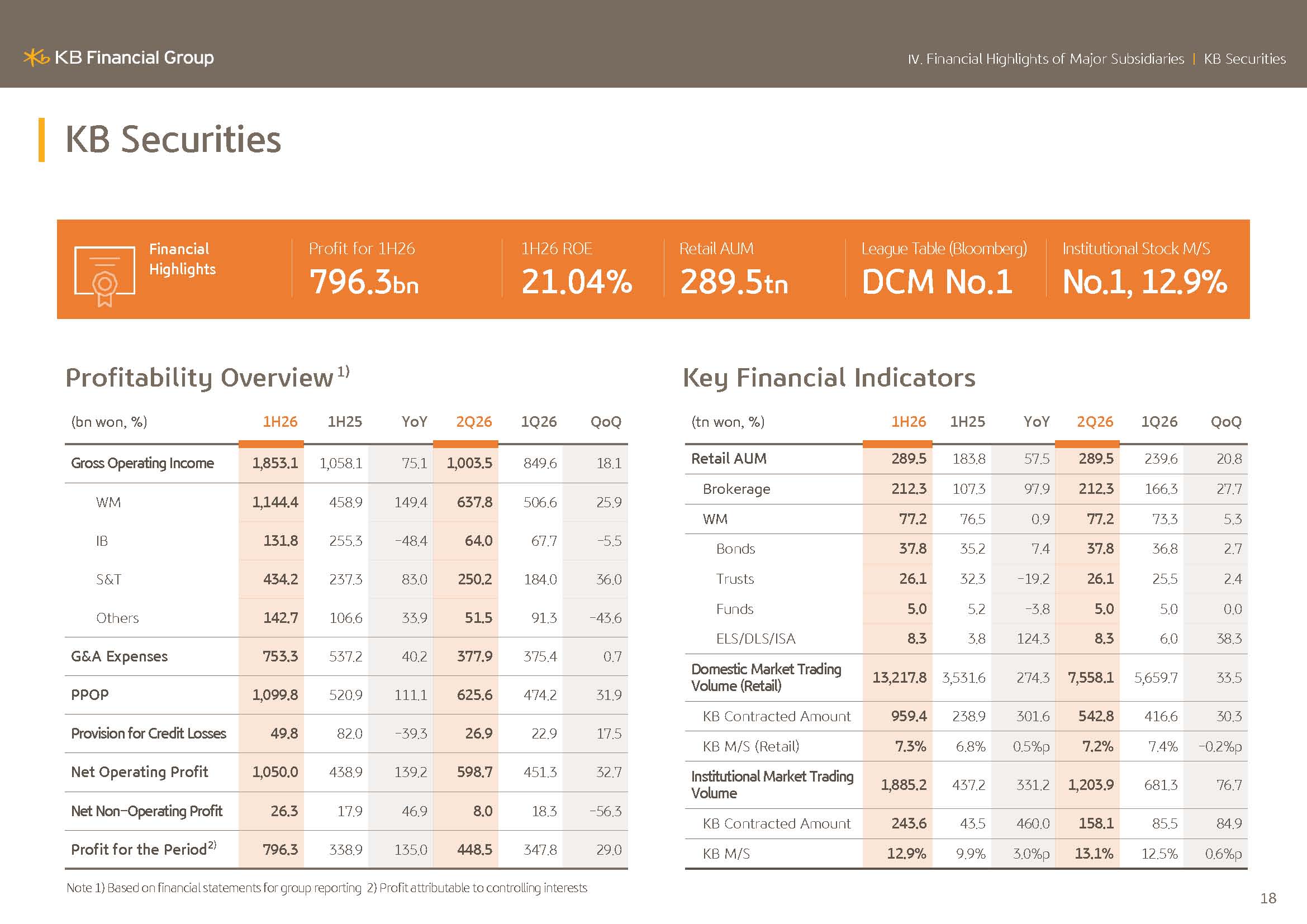
In particular, our security subsidiaries' contribution to the group's net income for the first half increased to approximately a 21% level, leading the growth in earnings from our non-banking business. Meanwhile, supported by this enhanced earnings capacity, the group's ROE for the first time -- for the first half also posted 14.09%, continuing its improvement trend.
For your reference, first half nonoperating profit declined significantly YoY. This was mainly attributable to a high base effect from the additional provisioning for ELS-related liabilities in the previous quarter and gains on the disposal of assets held by consolidated funds in the prior year.
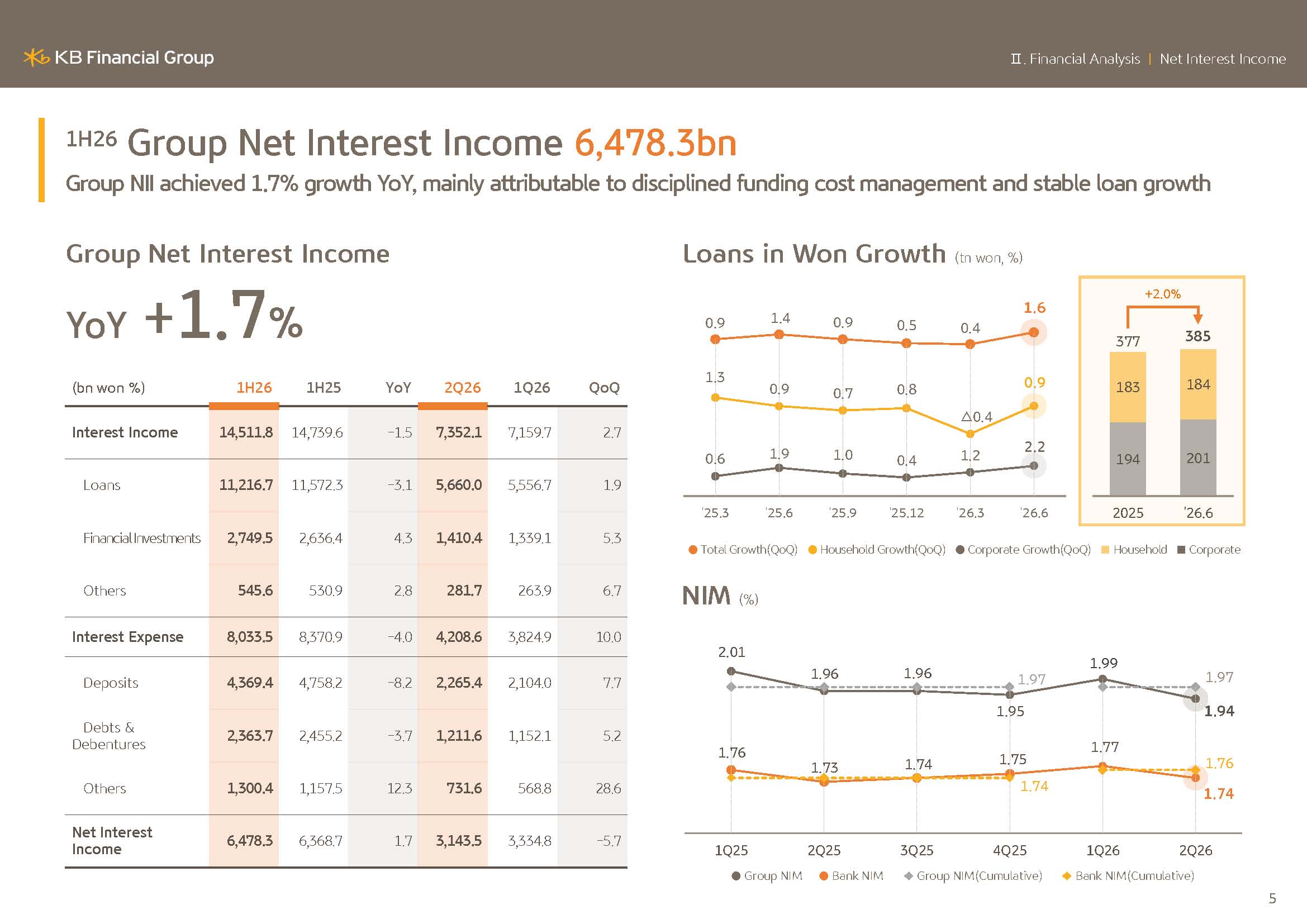
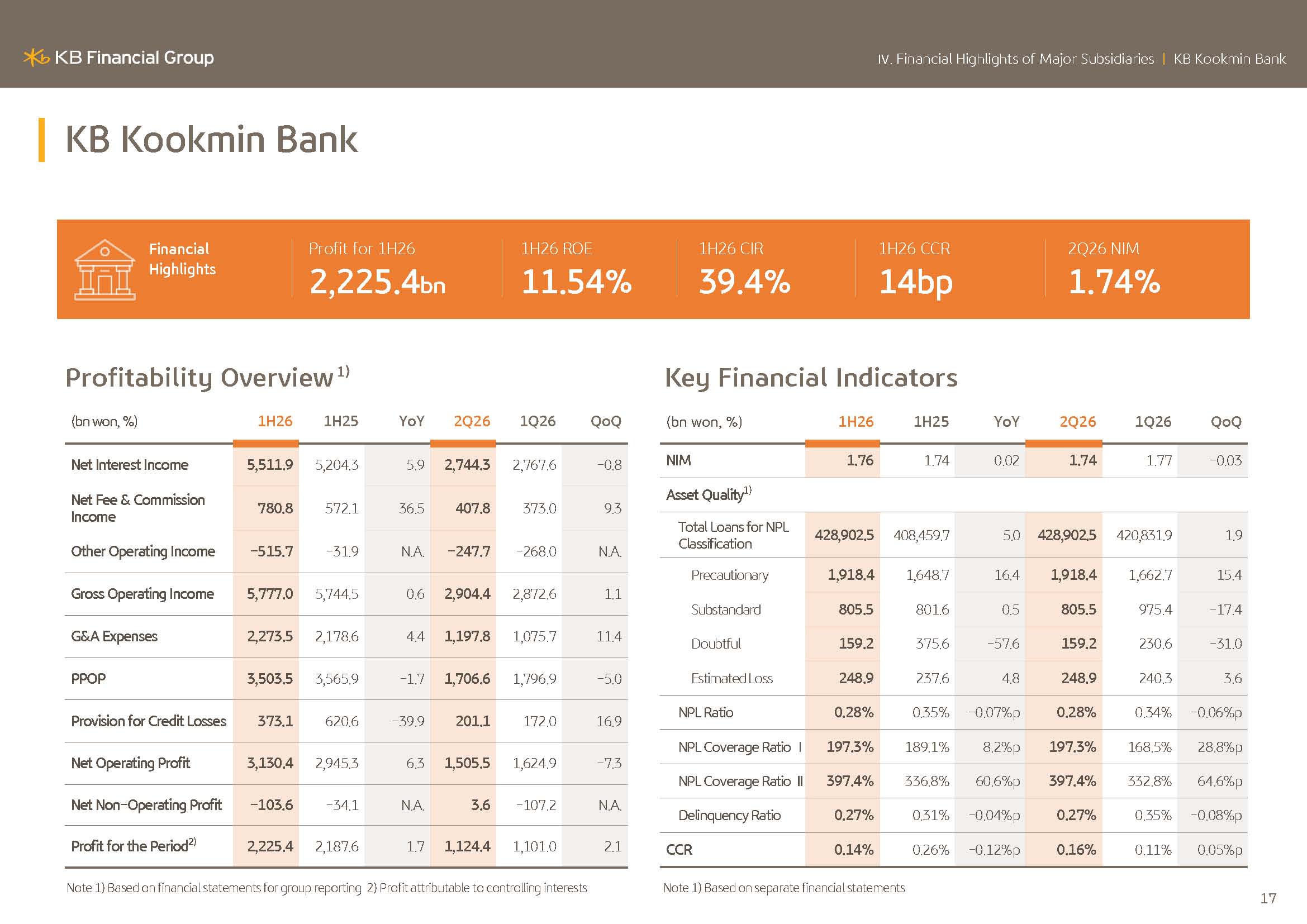
Let me now walk you through our financial results in greater detail by business segment. For the first half of 2026, the group's NII recorded KRW6.4783 trillion, a slight increase YoY. However, it was a slight decrease QoQ due to a slight drop in NIM from preemptive funding in anticipation of an interest rate hike in the second half of the year.
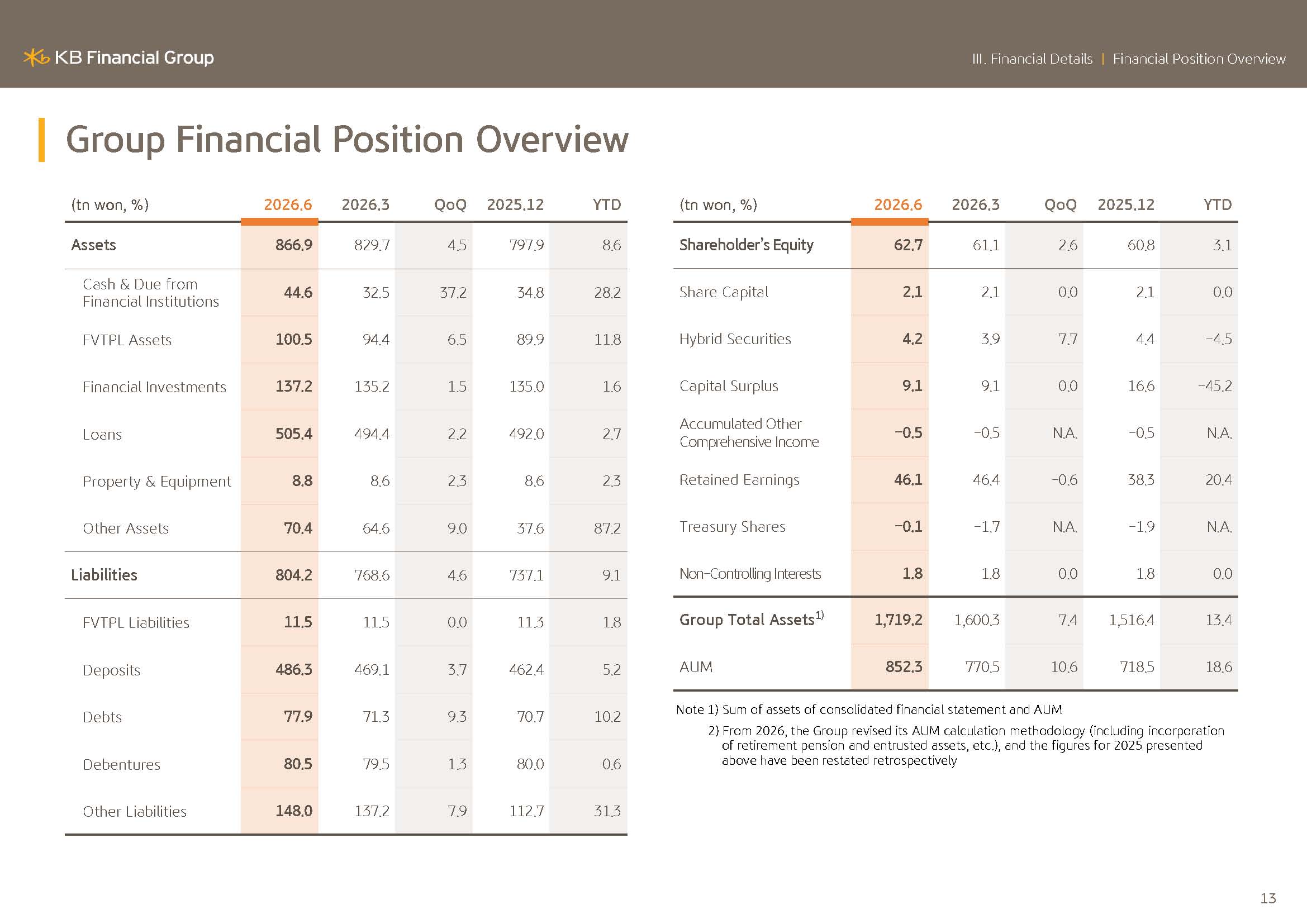
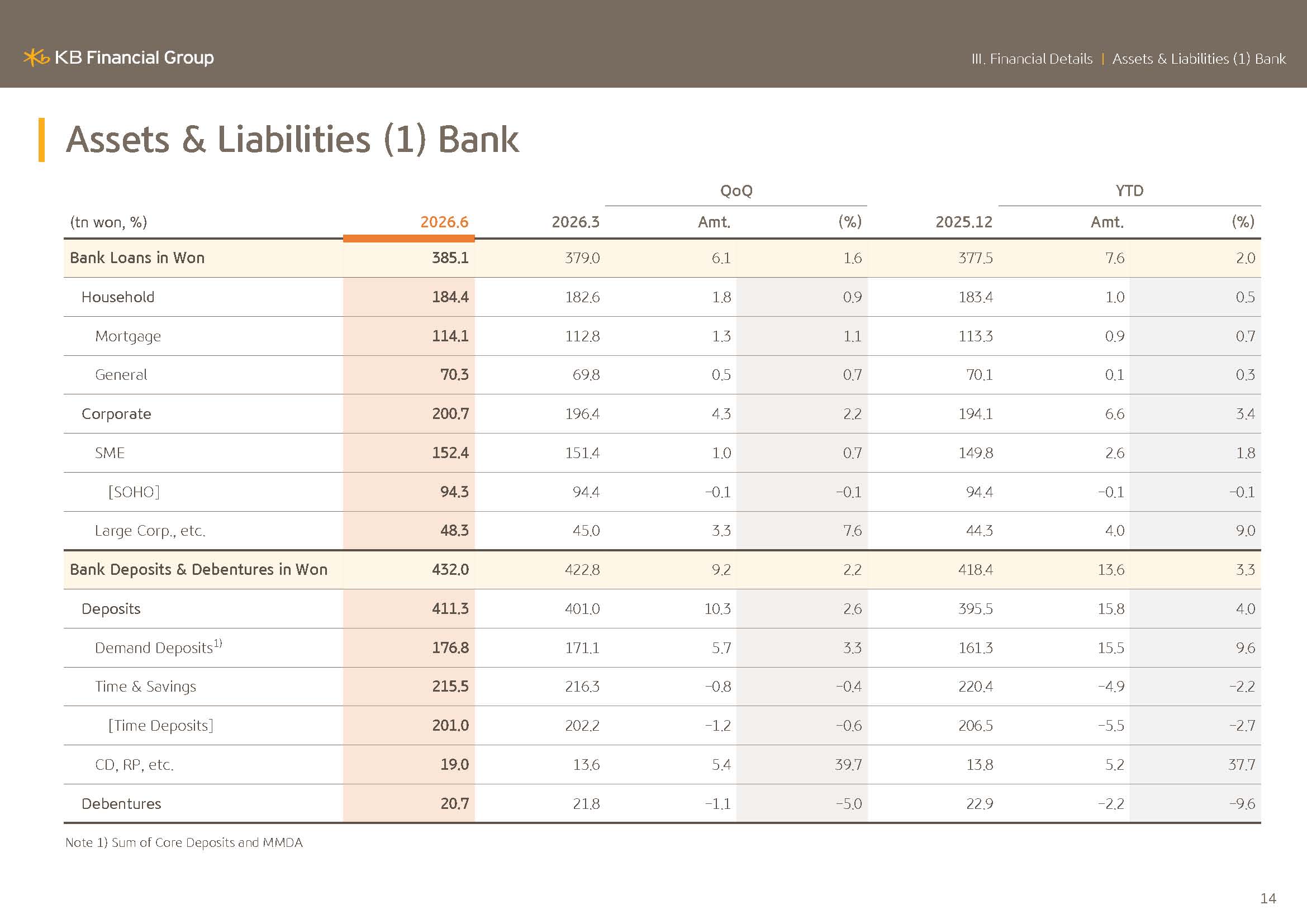
Next is growth of loans in Korean won. As of the end of June 2026, the bank loans in won amount to KRW385 trillion, up 2% over the end of 2025 and up 1.6% QoQ. Household loans shifted back to a solid growth trend, reaching KRW184 trillion, while corporate loans recorded KRW201 trillion, growing 2.2% QoQ, mostly thanks to the growth of productive financing. In the second half of the year, while not compromising asset quality, we plan to pursue our growth strategy with a focus on qualitative growth, such as portfolio shifts through productive financing.
Next, net interest margins on the bottom right.
Bank NIM for Q2 recorded 1.74%. Due to intensifying competition in corporate loans, yield on assets remained similar QoQ. The increase in marketable deposits along with preemptive funding in preparation for second half of the year market rate hike pushed up cost of fund, resulting in a NIM drop of 3 basis points QoQ.
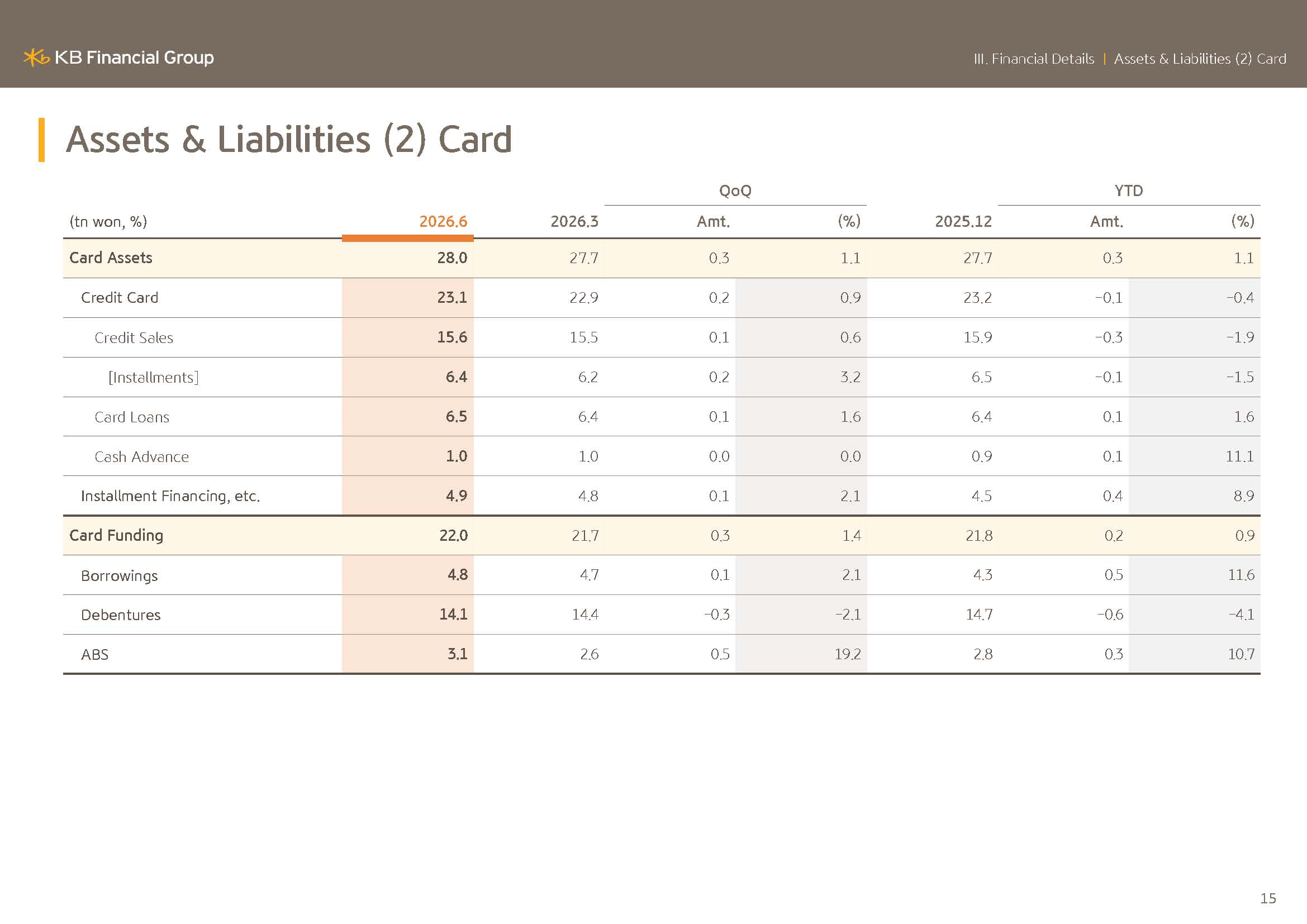
Meanwhile, group NIM, NIM, recorded 1.94% due to the impact of the lower bank NIM, combined with the decline in credit card financial assets and preemptive funding by KB Capital, group NIM is down 5 basis points QoQ. However, in the second half of the year with base rate hikes, asset and liability repricing effects and normalization of funding structures gradually incorporated, we expect NIMs to show an improving trend. Accordingly, on an annual basis, aligned with our forecast from the beginning of the year, we expect an improvement YoY.
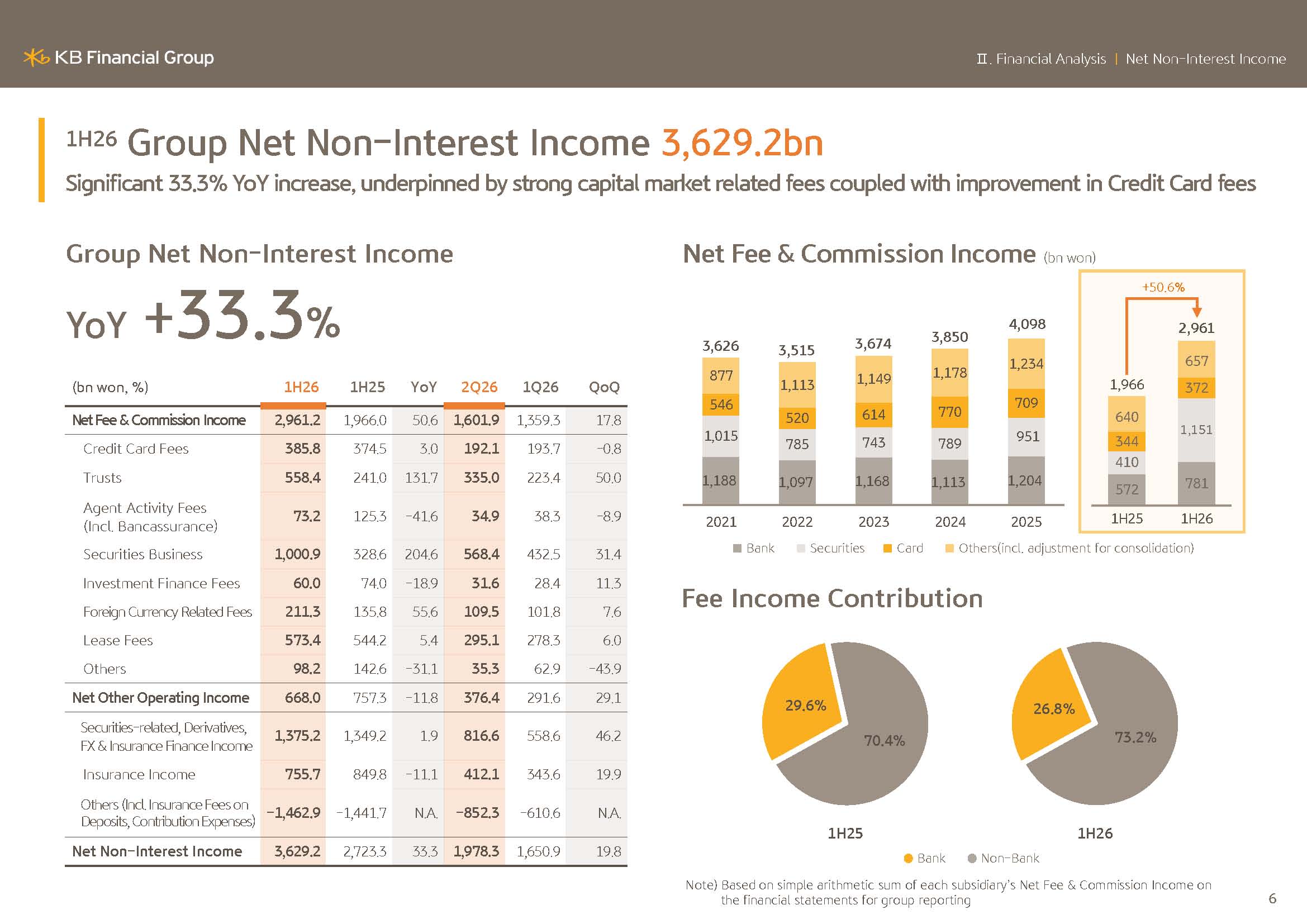
Next, noninterest income. Group noninterest income for the first half of the year recorded KRW3.6292 trillion, demonstrating a significant improvement of 33.3% YoY. In particular, cumulative net fee income for the first half reached approximately KRW3 trillion and in Q2 rose 17.8% QoQ to KRW1.6019 trillion, continuing a double-digit growth trend for three consecutive quarters.
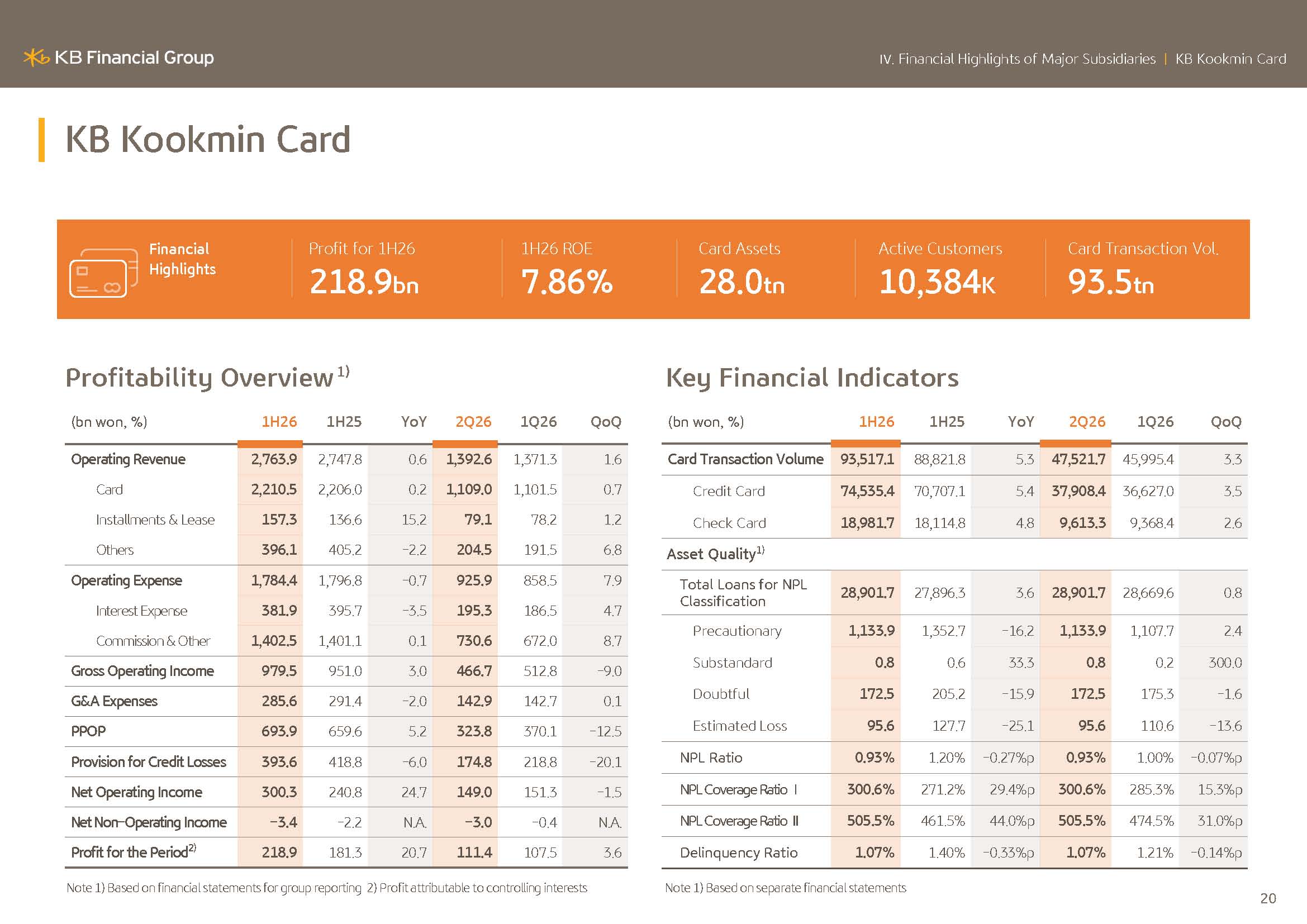
This was mainly driven by an expansion in securities brokerage fees under favorable stock market conditions alongside sales of capital market-linked products such as equity funds and ETFs by the bank, as well as an increase in personal credit card spending. As a result, net fee and commission income contributed more than 31% to our top line for the first time, driving the group's solid performance.
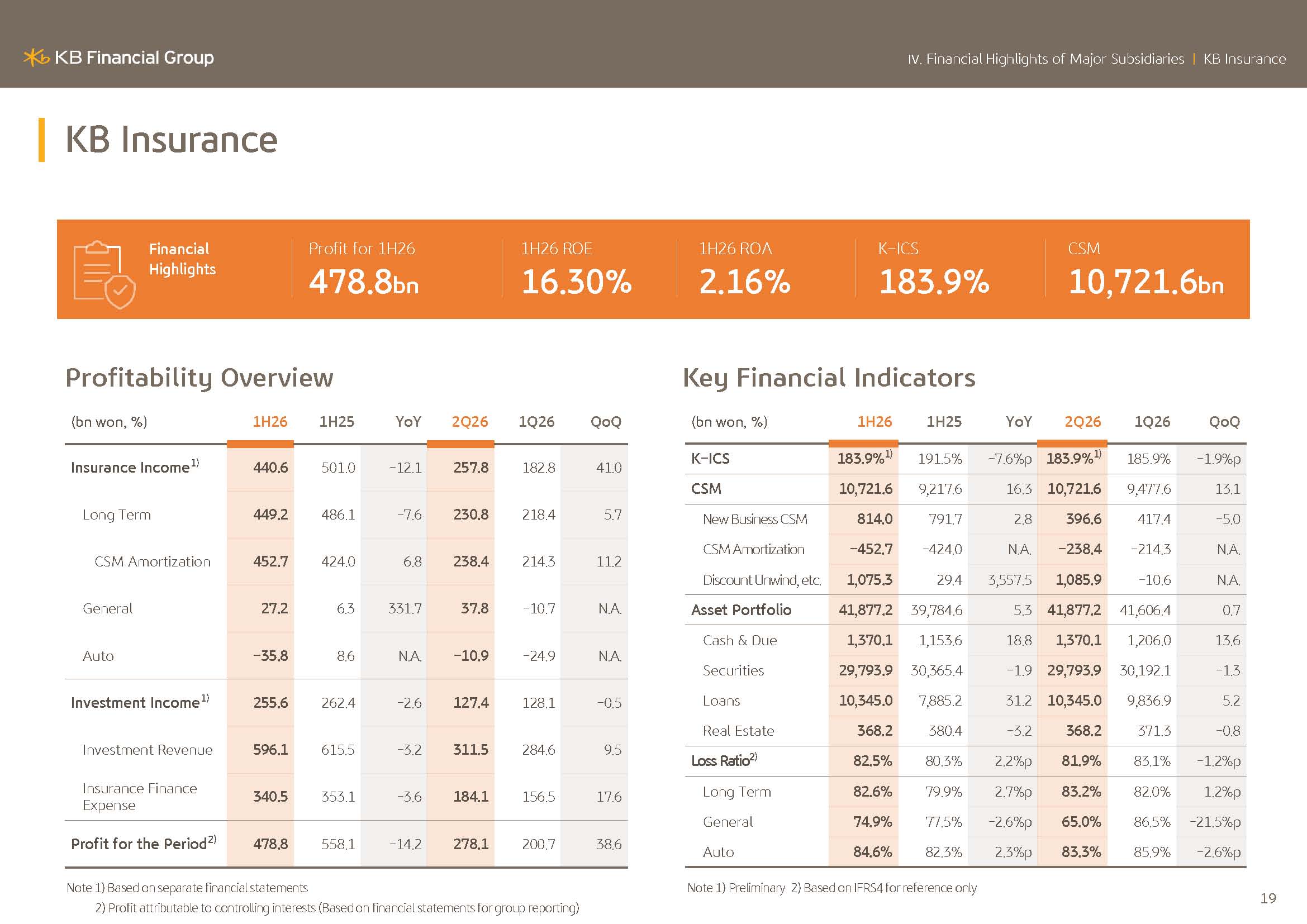
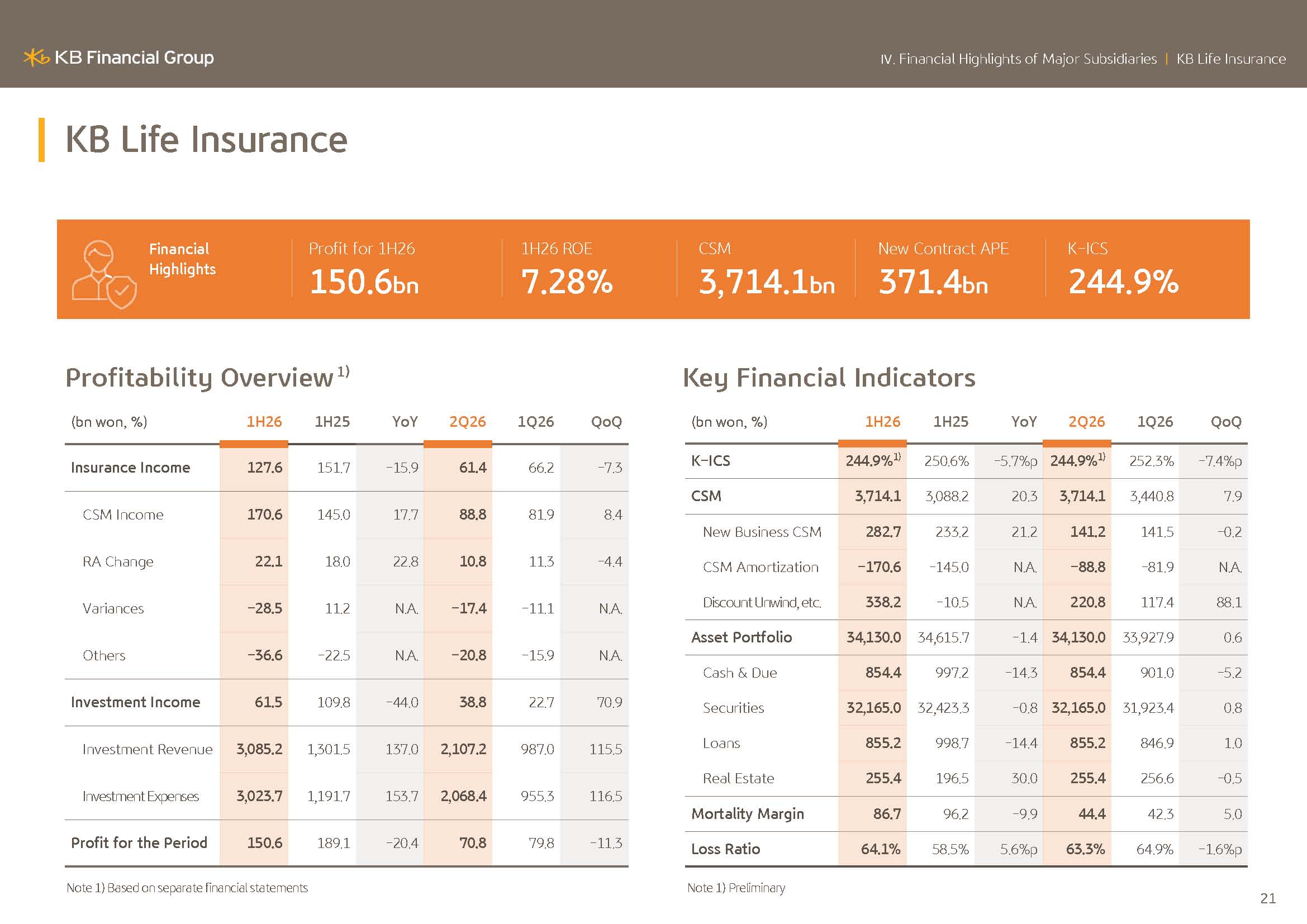
Meanwhile, as for the first half of the year's other operating income, mainly due to a decline in insurance income caused by rising loss ratios in long-term and auto insurance recorded somewhat sluggish results compared to the same period last year. However, in Q2, loss ratios showed improvement and with the addition of CSM impairment reversals, insurance operating income increased.
While promising industries such as AI and semiconductors led to a significant valuation gains on unlisted stocks at our investment subsidiary, resulting in a performance that rose 29.1% QoQ.
Next, moving on to general and administrative G&A expenses.
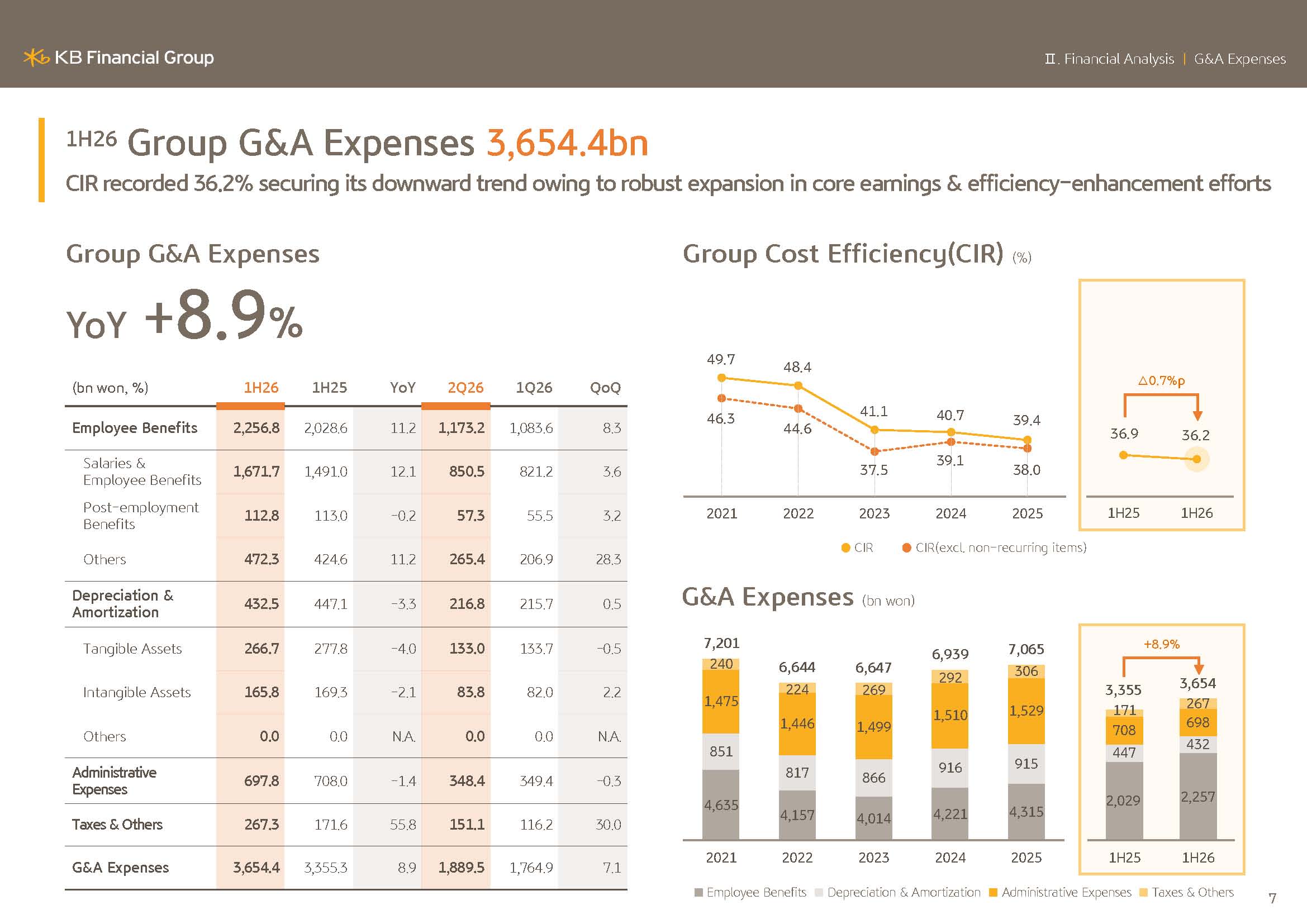
1H G&A expenses increased 8.9% YoY, but backed by solid growth in total operating income, the group CIR posted 36.2%. Excluding Q4, when one-off expenses such as ERP typically occur, the group has stably managed its CIR in the mid- to upper 30% range every quarter since 2023. Going forward, while actively expanding investments for future growth, we will strengthen earnings capacity and also efficiently manage recurring expenses to maintain a downward stabilizing trend in group CIR.
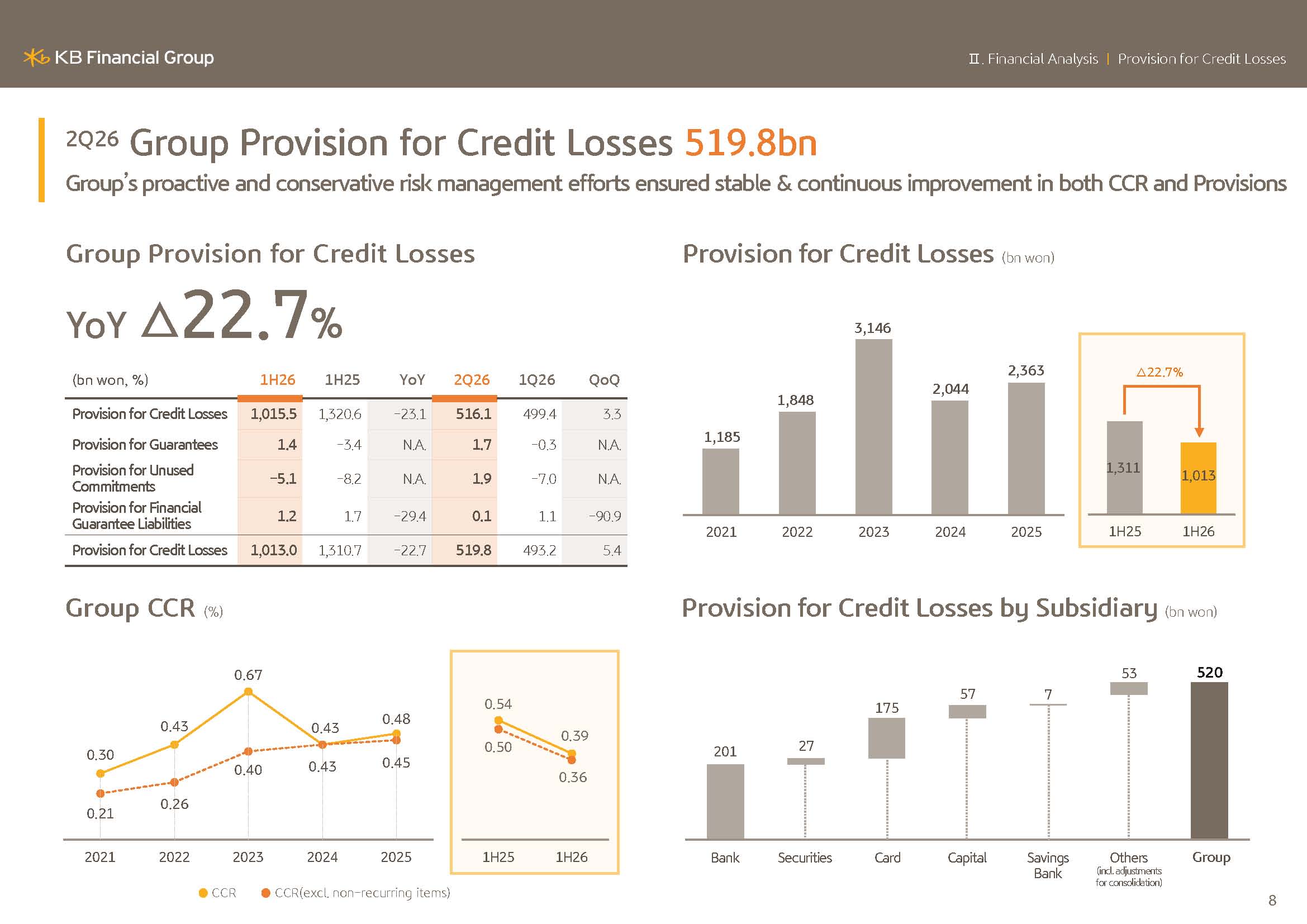
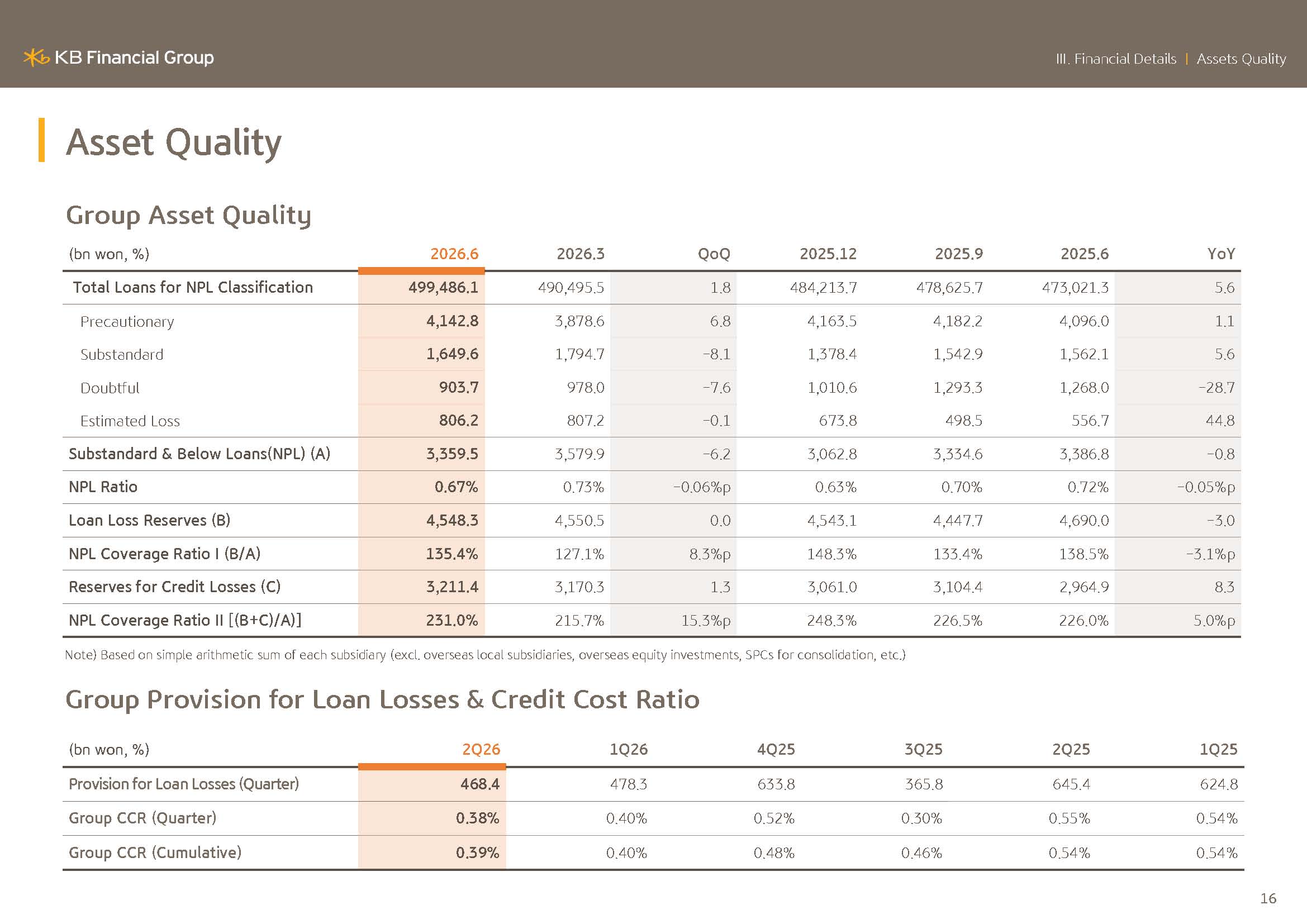
Next, on page 8 is the group provision for credit losses. Q2 credit loss provisions recorded due to one-off provisioning related to nonperforming corporate loans at the bank, it recorded KRW519.8 billion, a slight increase QoQ.
Excluding these one-off factors, the group's overall asset quality continues to show an improving trend. Particularly, KB Card's asset quality is stabilizing, primarily in personal cards and card loans, easing provision burdens, while the savings bank subsidiary is also seeing real estate PF-related risks gradually resolving. As a result, Q2 group credit cost recorded 38 bp falling QoQ. And on a cumulative basis for the first half, it came in at 39 bp, significantly improving by 15 bp YoY.
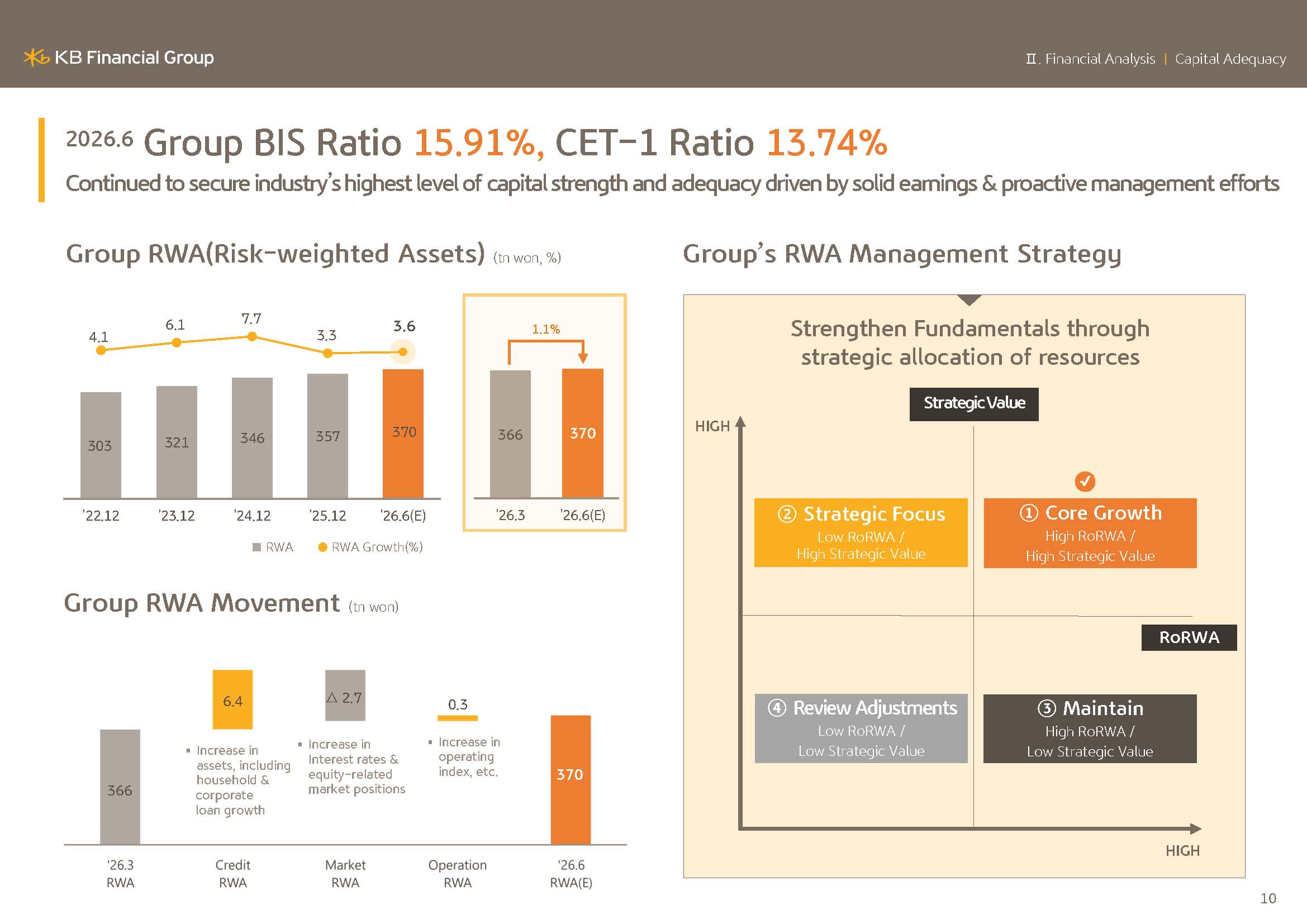
Lastly, moving on to group capital ratios. As of the end of June, preliminary estimates suggest a group BIS ratio of 15.91% and a CET1 ratio of 13.74%. Risk-weighted assets, RWA recorded approximately KRW370 trillion, up 1.1% QoQ, but remains well within our projected RWA annual growth target. To consistently deliver on our shareholder return commitment, we will maintain a balanced pace of asset growth while driving capital efficiency and profitability through RoRWA-oriented asset rebalancing.
Detailed breakdowns of our financial results are provided in the following slides for your reference. This concludes KB Financial Group's first half 2026 earnings presentation. Thank you for your time.